
Why Every Business Needs a Training Needs Analysis for AI Skills

Artificial intelligence is no longer a futuristic concept—it’s here, embedded in office tools, client services, and decision-making processes. From Microsoft Copilot to customer chatbots and data-driven insights, AI is shaping how organisations operate.
But here’s the uncomfortable truth: most workforces aren’t ready. Employees may have access to AI tools, but without the right skills, those tools go underused—or worse, misused. That’s where a Training Needs Analysis (TNA) for AI skills becomes essential.
Why AI Skills Are Different
Traditional training gaps (like Excel shortcuts or presentation skills) are relatively easy to spot. AI, however, requires a blend of technical know-how, ethical understanding, and workplace application.
Technical Literacy: Do staff know how to use AI responsibly and effectively?
Critical Thinking: Can they fact-check, validate, and interpret AI outputs?
Ethical Awareness: Are employees trained to recognise bias, data risks, and compliance implications?
Practical Application: Do they know how to embed AI into daily workflows for productivity and innovation?
Without mapping these areas properly, organisations risk creating a “skills illusion”—thinking staff are AI-ready when they aren’t.
Why a Training Needs Analysis (TNA) Matters
A TNA is the diagnostic step before launching any AI training program. It ensures learning investments target the real gaps, not assumptions. Done well, it:
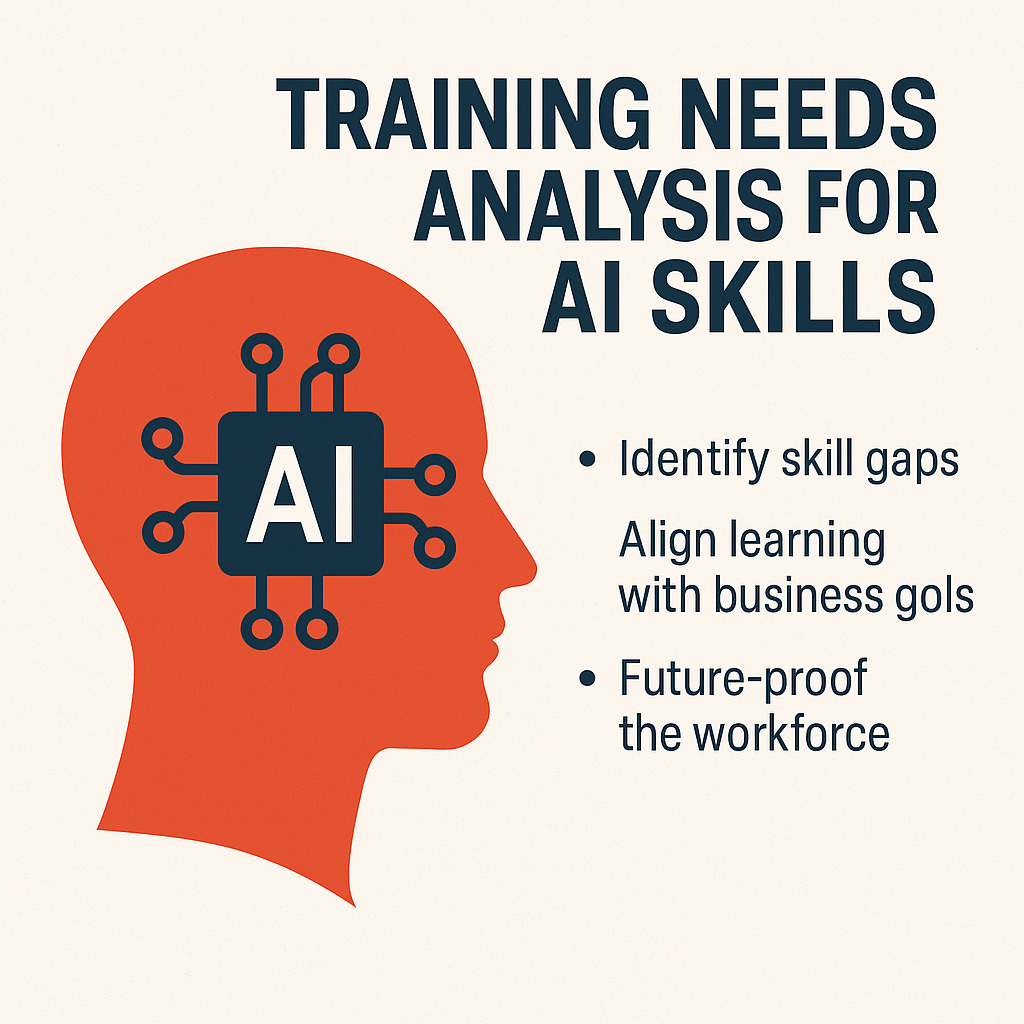
Aligns AI skills with business goals
– Example: A law firm may need AI for document review accuracy, while a retailer may prioritise AI-driven customer insights.Identifies hidden skills gaps
– Some employees overestimate their AI confidence, while others quietly avoid new tools.Prioritises high-impact training
– Resources go to the most urgent areas (e.g., cybersecurity risks with generative AI), not generic “AI 101” content.Future-proofs workforce capability
– AI is evolving fast. A TNA helps businesses plan beyond immediate needs to anticipate future skills.
How AI Can Help Run the TNA
Ironically, AI itself can make the TNA smarter and faster:
Survey Analysis: AI can cluster employee feedback into key themes.
Performance Data Insights: Algorithms can spot patterns that suggest AI training needs.
Predictive Gap Mapping: AI can forecast which roles are most at risk of falling behind.
The result? A clear roadmap for training that’s data-driven, strategic, and tied to measurable outcomes.
The Cost of Doing Nothing
Skipping a TNA for AI skills doesn’t just slow down productivity—it opens the door to compliance risks, poor adoption of expensive tools, and missed opportunities for innovation. Organisations that wait risk creating two workforces: one AI-ready, one left behind.
The Solution: Take the First Step Today
The first step is awareness—the next is action. That’s where I come in.
I help organisations conduct structured AI-focused Training Needs Analyses, giving you:
A benchmark of current workforce capability
A map of urgent and emerging AI skills gaps
A tailored training strategy that drives measurable impact
Don’t leave your AI adoption to chance. Equip your team with the skills they need to thrive.